Why AI Recommends Your Competitors Over Your Flooring Business
Your next customer might never type “flooring near me”. They’ll ask ChatGPT or Google’s AI Mode who to call and get a shortlist back. We’ve spent years helping businesses earn their place in search, and here’s what we’ve learned about why AI recommends some flooring businesses and not others.
Last Updated: 25 November 2026

What Does It Mean to Be Recommended by AI?
AI is changing the way people find tradespeople. When homeowners need new floors, more and more of them are asking an AI tool for help, and instead of a page of search results they get two or three recommended names, each with a reason why. That’s often where the decision gets made. For flooring businesses, that shortlist is fast becoming the new front page of Google.
Did you know?
37% of UK consumers used AI tools to find a local business in the past month, and three in four of them are using AI more than they were a year ago. AI has quickly become one of the ways people choose who to call.
Source: Yext 2026 Consumer Search Behaviours
This is exactly the kind of change we’ve been preparing our clients for at Unbranded Digital. The good news is that what gets a business recommended by AI isn’t a mystery, and it isn’t what most people expect.
This article is our take on why AI recommends some flooring businesses over others, and how we put it into practice for clients. We cover how AI decides who to trust, why great fitters get overlooked, what a strong flooring page looks like, and the shortcuts to steer clear of.
How AI Decides Which Flooring Businesses to Recommend
AI tools don’t pick favourites at random. They build a picture of your business from everything written about you across the web, then decide how confident they feel recommending you. The flooring businesses that come up are the ones that look reliable from every angle.
Below is how the two main types of AI search decide which businesses to trust:
Why Great Flooring Businesses Get Overlooked, and What Gets Them Recommended
When we look at flooring businesses that aren’t being recommended, it’s rarely because they’re bad at what they do. Often they’re brilliant fitters with years of happy customers behind them. The problem is that AI can’t see what their customers already know.
An old directory listing with the wrong phone number. A website that says “flooring” but never shows the craft behind the LVT, carpet and hardwood work. Glowing reviews that say “great job” without saying what the job was. None of these feel like a big deal on their own, but together they make a business harder for AI to understand, and harder to recommend.
There is no single switch that gets you into AI answers. In practice, we have found that these five things matter most.
1. Be Easy to Understand
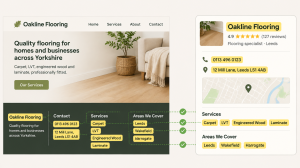
Your website, Google Business Profile, Bing Places, directories like Checkatrade and Yell, supplier listings and local press all feed the picture AI builds of you. When those pieces tell the same clear story, AI is confident. When they don’t, it quietly moves on to a competitor. Consistency matters for local search too: Google’s local results weigh relevance, distance and prominence, and matching business details, reviews and links all feed prominence.
We suggest: Checking that your business name, address, phone number, services and service areas match everywhere you’re listed, and being specific about the floors you fit.
2. Answer the Questions Homeowners Actually Ask
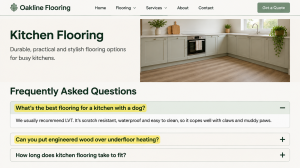
People talk to AI in full questions, not two-word keywords. “What’s the best flooring for a kitchen with a dog?” or “Can you put engineered wood over underfloor heating?” If your website answers those clearly and honestly, AI has something useful to draw from.
We suggest: Giving each flooring type and each main area you cover its own page, with short answers to the questions you hear on every home visit.
3. Be Upfront About Price
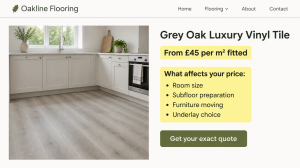
“How much does it cost?” is one of the first things homeowners ask, and AI looks for a clear answer. Many businesses resist publishing prices because every job is different, but you don’t need a fixed quote. A starting point with the variables explained is enough, and it’s exactly the kind of fact AI answers lift.
We suggest: Adding a “from” price or typical range for each flooring type, along with what affects the final cost, such as room size, subfloor preparation and materials.
4. Let Your Customers Do the Talking
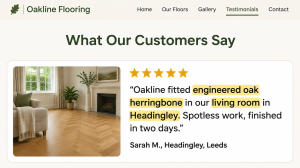
What other people say about you carries more weight than what you say about yourself. “Great service, 5 stars” is nice. A review that mentions the floor, the room and the area tells AI exactly what you did and where.
We suggest: Asking happy customers to mention the type of flooring and their area in their review, collecting reviews on independent platforms, and replying to every review you get.
5. Show the Craft Behind the Work, and Make It Checkable
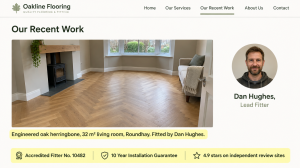
You know flooring inside out, and your website should prove it. Content that only someone who has done the job could write stands out a mile against generic pages that could have been written by anyone. Original, captioned job photos with a named fitter are an experience no competitor can copy. And every trust claim you make should be something AI, and customers, can verify.
We suggest: Using your own captioned job photos and project write-ups, with real names and faces behind the business, and backing up claims with accreditation numbers, clear guarantee terms and your company details.
What a Strong Flooring Page Looks Like
On a flooring service page, trust matters. Someone is about to let you into their home and spend thousands on a floor they’ll live with for years, so they want to know whether they can trust you and what it will cost.
Our checklist for flooring service pages:
- Build pages around real services: A dedicated LVT, carpet or engineered wood page matches what people ask for far better than one generic “services” page.
- Show the work: Original, captioned job photos with a named fitter are an experience no competitor can copy.
- Publish a price range: Even a starting price per m² with the variables explained is enough, and it’s exactly the kind of fact AI answers lift.
- Make every trust claim checkable: Accreditation numbers, guarantee terms, company details and reviews on independent platforms.
- Keep your business details consistent everywhere: Name, address, phone number and service areas should match across your website, Google Business Profile, Bing Places and directories.
- Prove the areas you cover: Recent jobs in each area beat a long list of towns every time.
Four AI Shortcuts That Don’t Work
There’s no shortage of people promising to get you “into ChatGPT” overnight. We steer well clear, and for good reason: Google now explicitly treats attempts to manipulate its AI responses as spam, and recovering from a penalty can take months.
Keyword-stuffed headings: Reads as spam to customers and gives AI nothing useful to quote.
| Shortcut | Why it does not work | ||
|---|---|---|---|
| Fake or paid-for reviews | Deceptive, against review platform rules and a spam policy risk. | ||
| A page for every town within 50 miles | Mass-produced pages with no real proof can fall under scaled content abuse. | ||
| “Guaranteed ChatGPT ranking” packages | Nobody controls what AI tools recommend. Trust is earned, not bought. | ||
| Keyword-stuffed headings | Reads as spam to customers and gives AI nothing useful to quote. |
We’ve never chased hacks, because they’ve never lasted. The results we get for our clients come from doing honest SEO well, and doing it consistently.
How We Help Flooring Businesses Get Recommended
Getting recommended by AI isn’t a box-ticking exercise. It takes a deep understanding of how search engines and AI tools read a business, what your customers are really asking, and how to show your expertise in a way that both people and machines trust.
That’s the work we do day in, day out. We bring together technical SEO, local SEO and generative engine optimisation with a genuine understanding of your trade, so your website, your listings and your reputation all pull in the same direction. It’s that joined-up approach that gets results, not any single quick fix.
The businesses AI recommends are the ones with clear information, genuinely helpful content, strong reviews and a solid reputation across the web. None of that happens by accident. And because we’re big on teaching, you’ll always understand why we’re doing what we’re doing, not just what’s been done. We build your confidence, not just your visibility.
Curious whether AI is recommending you or your competitors? Get in touch with us and we’ll show you how your flooring business currently appears in AI answers, and how our local SEO and generative engine optimisation services can get you on the shortlist. In the meantime, check out our Resin, Carpet & Safety Flooring pages to see some of our recent client work.
Sources: Google Search Central Spam Policies / Google AI Optimisation Guide / Yext: How UK Consumers Navigate Local Search in the Age of AI
Sharing Our Expertise
Related Guides
Our knowledge hub is where we share what we’ve learned to help you stay informed, grow your skills, and make smarter digital decisions with confidence.